In the Kingdom of Saudi Arabia, the Personal Data Protection Law (PDPL) has evolved from a regulatory requirement to a pillar of business integrity. As the grace period ends, organizations must transition from fragmented privacy efforts to a Sustainable Compliance Ecosystem.

A professional roadmap is more than a checklist; it is a strategic shield that protects the organization from financial penalties (up to SAR 5M) and commercial exclusion.
The PDPL Implementation Lifecycle
A successful roadmap follows a phased approach to ensure that data privacy is “baked into” the organizational DNA rather than “bolted on.”
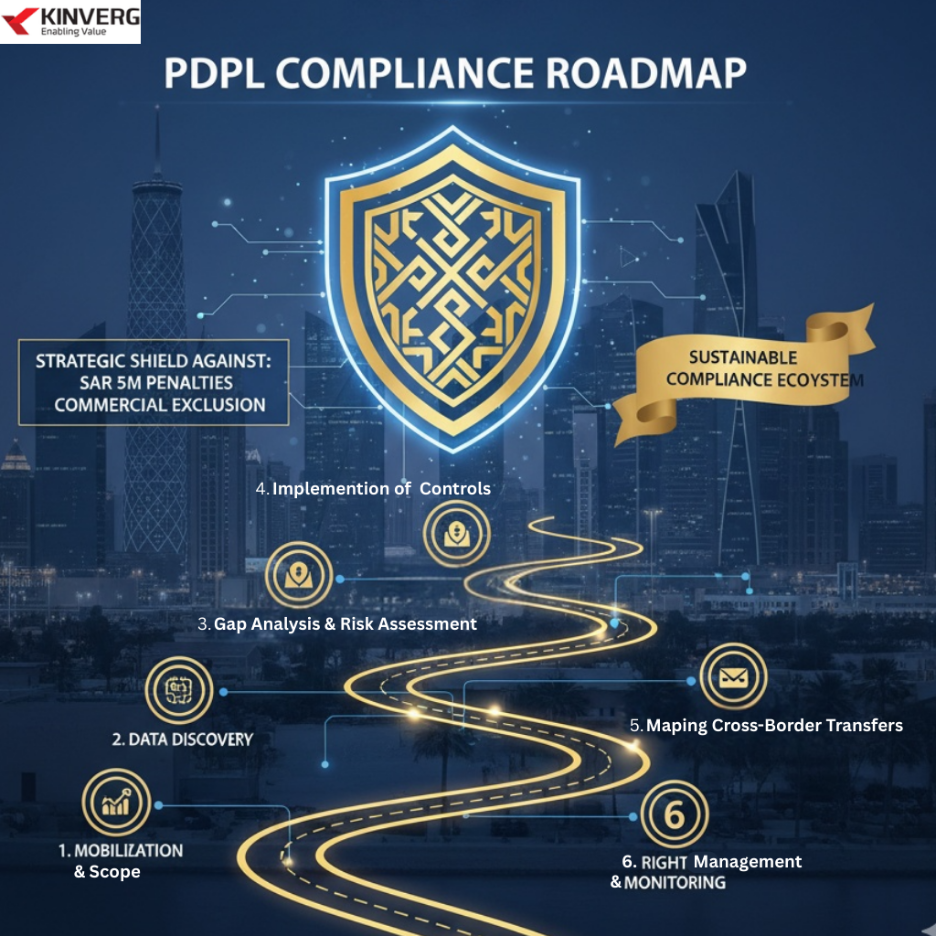
Phase 1: Mobilization & Scoping
Before fixing controls, you must define the legal and operational boundaries.
- Procedure: Determine if you process data of KSA residents (Customers/Employees).
- Key Output: A formal Scope Statement and the appointment of a Data Protection Officer (DPO) or equivalent governance lead.
Phase 2: Data Discovery & RoPA
You cannot protect what you cannot see. This phase involves a deep-dive into the “Data Journey.”
- Systematic Mapping: Identify where data is collected, where it is stored (Local vs. Cloud), and who has access.
- The RoPA: Create a Record of Processing Activities—the foundational document for any SDAIA (regulator) audit.
Phase 3: Gap Analysis & Risk Assessment
This is the “Diagnosis” phase. You must measure the distance between current operations and PDPL mandates.
- Visualizing Risk: Use a heat map to prioritize gaps. High-risk areas (like sensitive health or biometric data) must be addressed first.
- Legal Basis: Assign a lawful basis (Consent, Contractual, or Legal Obligation) to every processing activity.
Phase 4: Implementation of Controls
This stage converts analysis into technical and administrative action via Defense-in-Depth.
Category | Procedure / Mechanism |
Administrative | Bilingual Privacy Notices, Staff Training, Data Retention Policies. |
Technical | Encryption at rest/transit, Multi-Factor Authentication (MFA), Pseudonymization. |
Organizational | Privacy by Design (DPIAs) integrated into the Project Management Office (PMO). |
Phase 5: Managing Cross-Border Transfers
One of the most complex pillars of the Saudi PDPL is the restriction on moving data outside the Kingdom.
- Requirement: Ensure data localization for primary stores and utilize Standard Contractual Clauses (SCCs) for any permitted international transfers.
Phase 6: Right Management & Monitoring
The final phase empowers the “Data Subject” and ensures the program remains audit-ready.
- DSR Workflows: Standard Operating Procedures (SOPs) for Access, Correction, and Deletion requests.
- Continuous Monitoring: Monthly KPI tracking of breach detection times and training completion rates.
Key Performance Indicators (KPIs) for the CEO
To demonstrate success to leadership, track these four metrics:
- Compliance Score: Percentage of Annex controls fully implemented.
- DSR Latency: Average time taken to fulfill a user data request.
- Third-Party Risk: Percentage of vendors with signed Data Processing Agreements (DPAs).
- Training Reach: 100% completion rate for all employees handling personal data.

Conclusion
A mature PDPL roadmap transforms privacy from a regulatory burden into a Competitive Advantage. By building a transparent, resilient framework, you earn the most valuable currency in the world’s digital economy: Trust.
Ready to build a real PDPL roadmap, not just a policy on paper? Schedule your PDPL Gap Analysis with Kinverg today. Our experts will help you close critical gaps, prove compliance, and operate with confidence.