AI Governance in Practice: Preparing for ISO 42001 Before Regulation Catches Up
Every executive team is wrestling with the same uncomfortable truth. AI is being deployed faster than it is being governed. Models now shape hiring decisions, lending outcomes, customer service interactions, and product roadmaps, often without a clear answer to a simple question: who owns the risk if this goes wrong? That gap has stopped being a technical footnote. It is now a board level exposure, and boards are starting to ask about it directly.
The Business Pain Point
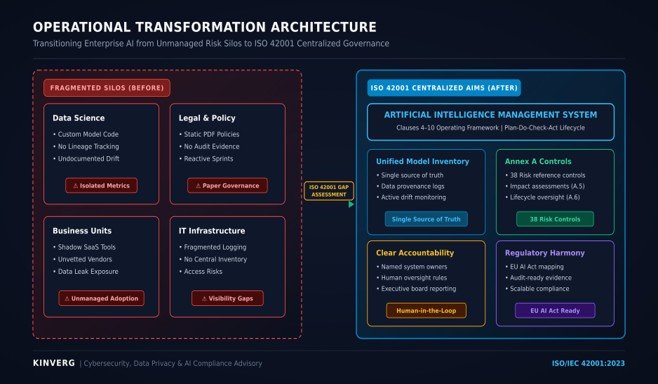
For most organizations, AI governance today means policies written on paper that nobody can actually evidence on demand. Risk assessments happen inconsistently across teams. Data lineage goes undocumented the moment a model moves from pilot to production. Model decisions cannot be explained to a customer, a regulator, or an auditor without a scramble through Slack threads and shared drives. Ownership is fragmented by design. Data science owns the model. Legal owns the policy language. Nobody owns the system that is supposed to connect them.
What Governance Gaps Actually Cost
The consequences are not abstract. They show up in the pipeline and on the balance sheet.
- Procurement stalls. Enterprise buyers increasingly require proof of governance maturity before a contract gets signed, and vague answers push deals into extended review cycles.
- Regulatory exposure compounds. As AI specific laws phase in across different jurisdictions, organizations without a system in place are forced into reactive compliance sprints every time a new requirement lands.
- Investor and insurer scrutiny rises. Governance maturity has become a standard line item in due diligence, and gaps here now affect valuation conversations, not just legal risk registers.
- Trust erodes fast. A single unexplainable or biased outcome that becomes public can undo years of brand equity in a news cycle.
One Gap, Four Different Titles
Ask a CEO, a CTO, a CISO, and a Head of Compliance to describe this problem and you will get four different answers that all point at the same hole.
- A CEO sees it as strategic risk sitting on the balance sheet.
- A CTO sees it as an architecture problem with no clear system boundary.
- A CISO sees it as an evidence problem, since nothing can be proven after the fact.
- A Head of Compliance sees it as an accountability problem, since no one owns the outcome when something goes wrong.
All four are describing the same missing piece: no management system tying AI activity together across the organization.
Why ISO 42001 Is the Practical Answer
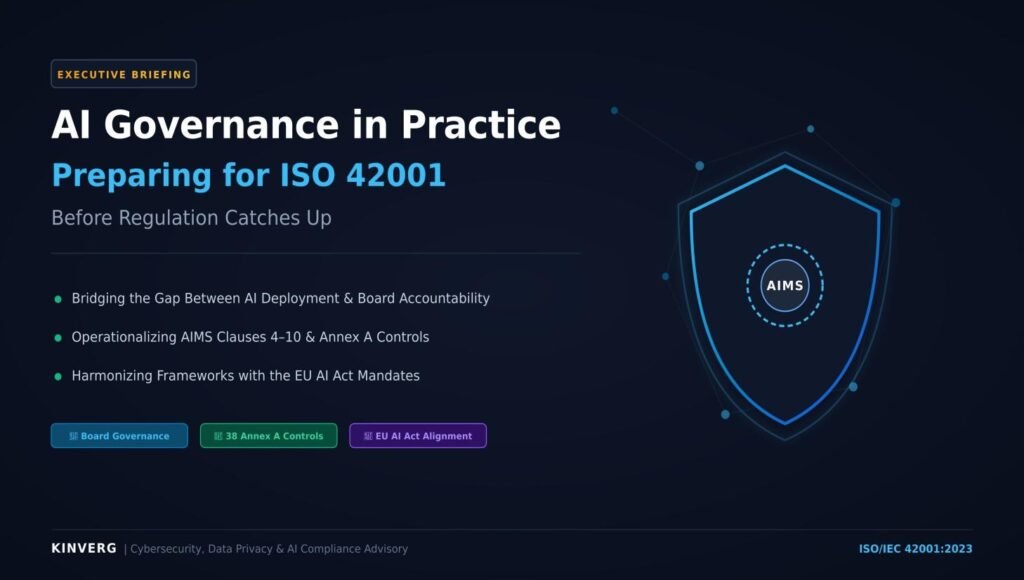
ISO/IEC 42001 is the first international standard for an AI Management System, commonly referred to as an AIMS. Its real value is not the certificate on the wall. It is the operating discipline the standard forces onto an organization: documented risk assessment across the full AI lifecycle, clear lines of accountability, data governance, human oversight, and continual review built into how AI actually gets used.
What an AI Management System Actually Covers
An AIMS built on ISO 42001 typically addresses the following in a structured, auditable way.
- Leadership accountability, so every AI system has a named owner rather than a diffuse committee.
- Lifecycle risk assessment, covering everything from data sourcing through deployment and monitoring.
- Human oversight thresholds, defining in advance where a person must intervene before a model output becomes a decision.
- Documentation as a byproduct of work, not a scramble triggered by an audit notice.
- Continual review, so the system improves as models, data, and regulations change.
How ISO 42001 Maps to Global Regulation
This structure maps directly onto what regulators are increasingly demanding worldwide, from the EU AI Act’s risk and transparency obligations to emerging frameworks in other jurisdictions. Build the management system once, and build it well, and it flexes to whatever comes next rather than requiring a rebuild every time a new law lands. Organizations that already run an AIMS are simply better positioned when a new regulatory requirement shows up, because the evidence already exists.
Practical Recommendations for Leadership Teams
- Inventory before you govern. Build a live register of every AI system in active use, including shadow AI that was adopted outside formal procurement channels.
- Assign clear ownership. Every AI system needs one named accountable owner, not a rotating committee that nobody can hold responsible.
- Treat documentation as infrastructure. Capture risk assessments and model decisions as they happen in the normal course of work, not after the fact under audit pressure.
- Set human oversight thresholds now. Decide in advance, and in writing, where a human must step in before a model’s output is allowed to become a decision.
- Run a gap assessment against ISO 42001 this quarter. Most organizations already have fragments of an AIMS scattered across teams. A structured assessment turns those fragments into an actual roadmap.
Key Takeaways
- AI governance gaps are a business risk, not a technical detail. They affect deals, capital, and reputation directly.
- Waiting for regulation to force compliance is the slowest and most expensive path to readiness.
- ISO 42001 gives leadership a single operational backbone that satisfies multiple current and future regulatory regimes at once.
- Ownership, documentation, and oversight thresholds are the highest leverage starting points available today.
- Governance maturity is quickly becoming a market differentiator, not just a compliance checkbox to tick off.
The Bottom Line
The organizations that lead in AI adoption over the next few years will not be the ones that moved the fastest without guardrails. They will be the ones that built governance into how they operate from the very start. ISO 42001 gives leadership teams a practical, internationally recognized way to do exactly that, well ahead of the deadlines that would otherwise force the issue.
The question worth raising at your next leadership meeting is not whether you can afford to build this system. It is whether you can afford to still be building it after a regulator, a customer, or a headline asks first.
Kinverg helps organizations build practical, audit ready AI governance grounded in ISO 42001, designed for how AI actually gets deployed, not just how it is described in a policy document.