In the age of rapid AI adoption, early-stage startups, especially those operating as SaaS providers and SMEs, face a unique dilemma: innovate fast or govern responsibly? The pressure to deliver AI-powered features quickly often clashes with the perceived complexity of formal governance frameworks like ISO/IEC 42001:2023, the world’s first international standard for an Artificial Intelligence Management System (AIMS).
With limited bandwidth, lean teams, and tight budgets, is achieving ISO 42001 compliance a realistic goal or a compliance burden only suited for tech giants? The answer, as many experts now confirm, is that it is achievable and increasingly a strategic necessity.
Why Should Startups Care About ISO42001?
ISO/IEC 42001:2023 is the first international standard for an Artificial Intelligence Management System (AIMS). It provides a structured, risk-based framework to help organizations govern the design, development, deployment, and use of AI systems responsibly. The standard focuses on managing AI-specific risks such as bias, lack of transparency, model drift, data quality issues, and over-automation, while ensuring human oversight, accountability, and continual monitoring across the AI lifecycle. Like ISO 27001, it follows the Annex SL structure, making it easy to integrate with existing management systems.
Importantly for startups and SaaS providers, ISO 42001 is scalable and technology-agnostic. Organizations can tailor controls based on the scope and risk of their AI use cases, making compliance achievable even with limited resources. As AI regulations evolve globally, ISO 42001 serves as a practical foundation for trust, regulatory alignment, and sustainable growth.
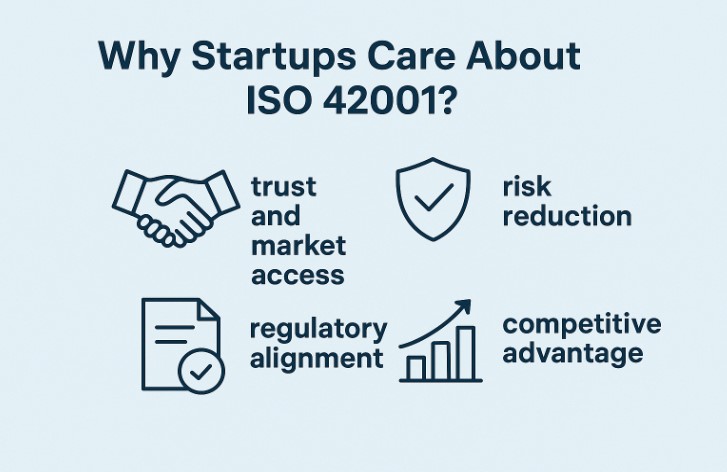
- Trust & market access: A documented AI management system reassures customers, partners, and investors that your AI is responsibly governed, a differentiator for B2B SaaS and regulated verticals.
- Risk reduction: ISO 42001 requires identification and treatment of AI-specific risks (bias, drift, data quality, supply-chain/model-vendor risk) so you can avoid costly incidents.
- Regulatory alignment: Implementing ISO 42001 helps you align with other frameworks and laws (NIST AI RMF, EU AI Act) that customers or regulators may demand. This reduces duplicate work later.
- Competitive advantage: Organizations that embed responsible AI practices into their development processes gain a clear competitive advantage. Both businesses and government agencies stand to benefit when they partner with an ISO 42001-certified provider, one that understands the nuances of AI governance, risk management, and compliance.
The Lean Approach: Right-Sizing ISO 42001 for Startups
The standard is designed to be scalable and applicable to organizations of all sizes. Startups can adopt a lean, risk-based approach to make ISO 42001 manageable.
- Don’t Isolate Rather Integrate: Leverage Existing ISO Frameworks
Many SaaS companies already pursue or hold ISO 27001 or SOC2 certifications. ISO 42001 utilizes the same Annex SL structure, which provides a shared blueprint for management systems. This consistency enables a unified approach to policy, risk management, and continual improvement, allowing you to slot AI controls into existing routines.
- Actionable Tip: Don’t create a separate compliance function. Integrate the new AI-specific controls (Annex A) directly into your existing Information Security Management System (ISMS) or Quality Management System (QMS).
- The Power of Scoping: Limit Your AIMS
A startup doesn’t need to certify every single internal use of AI immediately.
- Define a Narrow Scope: Start by applying the Artificial Intelligence Management System (AIMS) only to the highest-risk, customer-facing AI features (e.g., your automated credit-scoring model, not your internal spell-checker). This drastically reduces the scope of documentation and auditing required.
- Focus on the Core of Annex A: Prioritize the controls essential for responsible AI, particularly the AI Impact Assessment (AIIA) (Annex A Control A.5.2) and the controls related to human oversight and transparency (Annex A Controls A.8.5.3, A.8.5.5).
- Documentation for Audit, Not for Shelf-Life
Documentation is often the biggest resource drain. For lean teams, the goal should be minimal, auditable, and living documentation.
- AI System Inventory: Keep a simple, central log of all AI systems under scope, including their intended use, data sources, and the name of the AI System Owner (who is accountable).
- Leverage Compliance Automation Tools: Modern Governance, Risk, and Compliance (GRC) platforms are essential for startups. These tools automate evidence collection, streamline risk assessments, and provide templates for policies, drastically cutting down on manual overhead and time spent in audit prep.

Lightweight metrics & evidence (what to measure first)
Start with 4–6 monitoring indicators that give you meaningful signals:
- Model performance vs baseline (accuracy, precision/recall) — monthly.
- Data drift score (feature distribution change) — weekly/continuous.
- Bias checks on key protected attributes — per release.
- Number of AI incidents / customer complaints — rolling 90 days.
- Third-party vendor compliance checks completed — per vendor.
How to save money: pragmatic shortcuts that auditors accept
- Leverage existing systems: Reuse ISO 27001 or ISO 9001 processes (risk register, asset inventory, change control). ISO 42001 complements them; you rarely need entirely new systems.
- Use open templates & playbooks: NIST AI RMF Playbook and industry guides provide pragmatic controls that map to ISO 42001. You can adopt their suggested low-cost actions.
- Cloud & vendor compliance docs: Major cloud providers publish compliance offers and evidence (e.g., model hosting, encryption). Leverage those instead of building everything internally.
- Phased certification approach: Aim first for an internal AIMS and external attestation (or customer audits) before going for formal third-party certification if that’s needed later.
Special considerations for SaaS & multi-tenant products
- Data separation & tenancy: For strong logical separation and clear data, use policies that reduce client risk and simplify AI impact analysis.
- Model personalization vs safety: To ensure that personalized models do not expose more privacy/bias risk, add a mandatory privacy & fairness check when modeling personalize outputs.
- Change control on shared models: For multi-tenant improvements, treat model updates like software releases: canary deploy, rollbacks, and post-release monitoring.
The SaaS Imperative: Building Trust for Enterprise Deals
For AI-driven SaaS startups, ISO 42001 is a strategic differentiator. Enterprise buyers are increasingly concerned about their vendors’ AI governance, especially with the imminent enforcement of regulations like the EU AI Act.
- Presumption of Conformity: ISO 42001 certification acts as a strong signal of responsible and ethical AI use. It helps assure clients, investors, and regulators that your product manages risks associated with bias, explainability, and data integrity proactively.
- Clear Responsibility Lines: The standard helps SaaS providers clearly define the boundary between the AI System Provider’s responsibilities (the model and infrastructure) and the Client’s responsibilities (configuration and human oversight of the output).
Conclusion: Governance as a Growth Enabler
ISO 42001 for a startup is not a regulatory trap; it is a trust-building framework and a risk-mitigation tool. While resource constraints are real, adopting a lean, scoped, and integrated approach allows SMEs and early-stage companies to embed governance without sacrificing speed.
The initial investment is estimated to be manageable for small teams, pays dividends by securing larger contracts, attracting investment, and ensuring future-proof compliance against global AI legislation. For the modern AI-driven company, responsible governance is simply non-negotiable for long-term survival and scale.