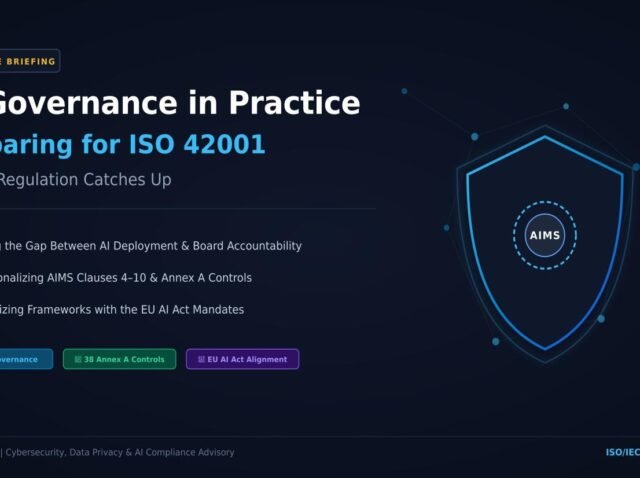
As artificial intelligence reshapes industries globally, two pivotal frameworks now define the landscape of responsible AI governance: ISO/IEC 42001:2023, the world’s first international AI management system standard, and the EU Artificial Intelligence Act (EU AI Act), the first comprehensive AI regulation by a major jurisdiction. Understanding both is no longer optional for organizations operating in or targeting global markets.
“Together, ISO 42001 and the EU AI Act form the twin pillars of a mature, trustworthy AI governance strategy; one builds the management system, the other enforces the rules.”
ISO 42001
ISO/IEC 42001 is a voluntary, globally applicable standard that provides a structured framework, an AI Management System (AIMS), for organizations developing, deploying, or using AI. Modeled on the familiar Plan-Do-Check-Act (PDCA) cycle, it covers:
• AI risk assessment and treatment processes
• Leadership accountability and governance structures
• Transparency, fairness, and human oversight obligations
• Continual improvement and third-party certification readiness
EU AI ACT
The EU AI Act is a legally binding regulation that applies to any organization placing AI systems on the EU market or using AI to affect people in the EU. Its foundation is a risk-based classification:
• Unacceptable Risk: Banned outright (e.g., social scoring, real-time biometric surveillance)
• High Risk: Strict conformity requirements (e.g., recruitment, credit scoring, medical devices)
• Limited Risk: Transparency obligations (e.g., chatbots)
• Minimal Risk: No obligations, encouraged best practices
Non-compliance can attract fines of up to €35 million or 7% of global annual turnover, whichever is higher.
Comparison

KEY DIFFERENCES

COMPLEMENTARY & NOT COMPETING
The most effective AI governance strategies treat ISO 42001 and the EU AI Act as complementary layers of a unified compliance posture. ISO 42001 provides the management infrastructure, risk processes, governance structures, documentation, and internal audits that directly support demonstrating conformity under the EU AI Act.

Organizations that implement ISO 42001 first are significantly better positioned to meet EU AI Act high-risk conformity requirements; the AIMS artifacts become direct evidence for regulators.
CONCLUSION
ISO 42001 and the EU AI Act are not rivals; they are two sides of the same coin. ISO 42001 gives your organization the governance system; the EU AI Act gives you the regulatory imperative. Together, they create a framework for deploying AI that is lawful, ethical, and commercially sustainable.
Organizations that act now, embedding AI governance into strategy rather than treating it as a compliance checkbox, will hold a decisive advantage in the AI-driven economy of tomorrow.
At Kinverg, we offer expert consultancy to help your organization navigate both ISO 42001 and the EU AI Act, from gap assessments to full certification readiness. Contact us today and let our specialists build a governance framework that keeps you compliant, competitive, and future-ready.