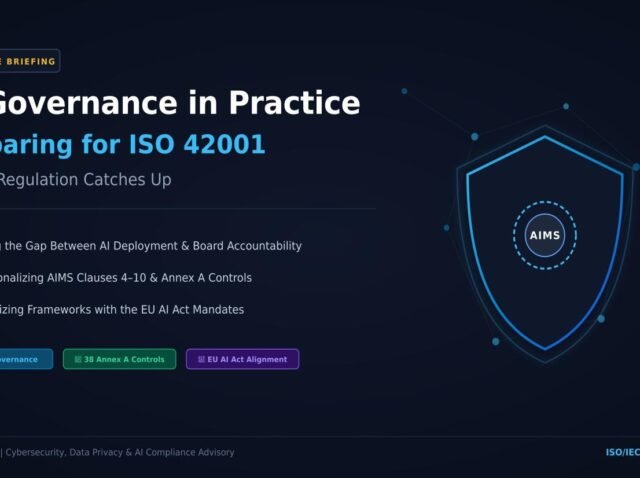
Artificial Intelligence (AI) is moving from ‘pilot’ to ‘production’ faster than most governance programs can keep up. And while the promise is real, which is the provision of automation, decision support, and productivity gains, so is the risk surface equally real, which includes opaque model behavior, novel supply chains, sensitive data leakage, third-party dependencies, and regulatory attention that is accelerating worldwide.
In my work experience as a senior cybersecurity consultant focused on GRC and data privacy, I have found that the hardest part is not picking a framework; rather, it is managing AI risk across multiple frameworks without duplicating effort, creating audit fatigue, or missing the gaps between them.
This blog is a practical AI readiness checklist to help you build a unified approach that aligns with common enterprise obligations such as security, privacy, compliance, and operational resilience while staying framework-aligned.
Why multi-framework AI risk management is now the default
Most organizations do not operate under one rulebook; rather, they are aligning with several of these at once:
- NIST AI RMF (AI governance and risk outcomes)
- ISO/IEC 42001 (AI management system)
- ISO 27001 / 27002 (security requirements)
- NIST CSF 2.0 (security outcomes)
- Privacy frameworks (GDPR, local privacy laws, ISO 27701, etc.)
- Sector-based regulations (finance, healthcare, telecom, critical infrastructure)
The goal is not to implement them all. But the goal is to design one control system that can be evidenced in many ways.

A Practical AI Readiness Checklist (Built for Cross-Framework Alignment)
1) Governance: Define ownership before you define controls
AI programs fail governance audits when nobody clearly owns the decisions.
Checklist
☐ Assign executive accountability for AI risk (named role, documented charter)
☐ Establish an AI Governance Committee (Security, Privacy, Legal, Product, Risk, Procurement)
☐ Create AI risk acceptance thresholds and approval pathways
☐ Define model lifecycle gates (intake → build/buy → test → deploy → monitor → retire)
☐ Maintain an AI system inventory (models, vendors, datasets, use cases, users, environments)
2) Use-case intake: Control AI by controlling why it exists
A surprising number of AI incidents trace back to poorly framed use cases having issues like unclear purpose, unstable requirements, or AI inclusion just for the sake of including AI to make it look fancier.
Checklist
☐ Classify each use case by impact (low/medium/high) and decision criticality
☐ Identify whether the AI supports advice, automation, or decisioning
☐ Define prohibited uses (e.g., sensitive profiling, unreviewed automated decisions)
☐ Require a documented business justification and measurable success criteria
☐ Include manual intervention where needed (especially for high-impact outcomes)
3) Data privacy & protection: AI data flows must be explicit (not assumed)
AI magnifies privacy issues like data reuse, purpose drift, retention uncertainty, and model outputs that can unintentionally reveal sensitive information.
Checklist
☐ Map data flows end-to-end (collection → processing → training → inference → storage → deletion)
☐ Validate lawful basis and purpose limitation for every dataset
☐ Apply data minimization (only what is necessary for the model to perform)
☐ Define retention for prompts, logs, embeddings, training sets, and outputs
☐ Conduct privacy assessments where required (e.g., Data Protection Impact Assessment (DPIA) / Privacy Impact Assessment (PIA))
☐ Evaluate cross-border transfers and vendor sub-processors
☐ Confirm user notice and transparency requirements (where applicable)
4) Security architecture: Treat AI as a new application tier
AI changes the threat model by introducing unique threats: prompt injection, data exfiltration via model behavior, model theft, poisoning, and insecure plugins/tooling.
Checklist
☐ Threat model the AI system (including tools, plugins, APIs, and Retrieval Augmented Generation (RAG) components)
☐ Implement access control and segmentation for model endpoints and datasets
☐ Protect secrets (API keys, system prompts, connectors) using vaulting and rotation
☐ Define secure SDLC for AI (code review, dependency scanning, Infrastructure as Code (IaC) controls)
☐ Add safeguards against prompt injection and unsafe tool execution
☐ Implement DLP controls for prompts, outputs, and logging pipelines
☐ Validate encryption in transit/at rest; ensure audit logs and monitoring
5) Third-party & supply chain risk: Know what you are buying and what risks it introduces.
AI supply chains have layers, which include foundation models, cloud platforms, vector databases, observability tools, labeling services, and data brokers. Therefore, different risks are linked to them.
Checklist
☐ Vendor due diligence tailored to AI (model provenance, training data claims, security posture)
☐ Review contracts for data usage, retention, model training on your data, breach obligations
☐ Confirm sub-processors and hosting locations
☐ Require vulnerability disclosure, audit rights, and incident notification Service Level Agreements (SLAs)
☐ Validate model update/change management (what changes, when, and how you are informed)
6) Model risk management: Test what matters instead of following trend
For many organizations, the gap is not lack of testing; rather, it is lack of relevant testing tied to actual harm.
Checklist
☐ Define risk scenarios: incorrect advice, harmful output, biased outcome, data leakage
☐ Validate performance against realistic inputs and edge cases
☐ Evaluate robustness (jailbreak attempts, adversarial prompts, data poisoning risks)
☐ Implement guardrails (policies, filters, refusal behavior, tool restrictions)
☐ Create rollback plans and kill switches for high-risk deployments
☐ Ensure model changes are versioned, reviewed, and approved
7) Transparency & explainability: Define what ‘explainable’ means for your context
Not every AI needs deep interpretability, but every AI needs traceability; that is, what data was used, what version was run, and why the output was produced.
Checklist
☐ Maintain documentation including but not limited to model cards, data sheets, intended use, limitations
☐ Provide user-facing disclosures where needed (AI-assisted content/decisions)
☐ Ensure traceability for RAG, including sources retrieved, citations, retrieval logs, etc.
☐ Document decision boundaries and escalation paths (when humans override AI)
8) Operations: Monitoring and incident response must include AI-specific triggers
AI incidents do not always look like traditional security incidents. Sometimes the problem is not a hacker breaking into your system. The problem is the AI itself saying or showing something it should never share, like private customer details, confidential company info, or passwords, because someone asked it in a tricky way, or it pulled out the wrong data. In another case, the AI might start giving bad or harmful answers to lots of people at once (for example, wrong medical advice, unsafe instructions, discriminatory responses, or false information). Since AI can respond very fast and to many users, that harm can spread quickly.
Checklist
☐ Define AI incident categories (data exposure, harmful content, unsafe automation, integrity drift)
☐ Establish monitoring for output anomalies, prompt injection patterns, and unusual tool calls
☐ Put in place abuse detection and rate limiting
☐ Create a playbook: triage → containment → investigation → comms → remediation
☐ Include AI providers in your incident coordination plan
9) People & training: The strongest control is still a well-trained workforce
Most AI failures are not sophisticated attacks; they are process failures like unsafe data sharing, poor prompt hygiene, unclear responsibilities, etc.
Checklist
☐ Role-based training (developers, analysts, business users, leadership)
☐ Policies for acceptable use, sensitive data, and external AI tools
☐ Clear guidance for prompt content, output verification, and citation requirements
☐ Red-team exercises: simulate misuse and validate controls
A simple way to map this across frameworks
Here is the approach I recommend:
Build one control library for AI (governance, privacy, security, vendor risk, monitoring).
Tag controls by framework mapping (e.g., NIST AI RMF, ISO 42001, ISO 27001, privacy requirements).
Centralize evidence (inventories, assessments, test results, approvals, monitoring dashboards).
Run audits and internal reviews against the evidence, not against ad-hoc narratives.
This reduces duplication and makes your program resilient even as frameworks evolve.

If you are trying to map your AI controls across different frameworks without duplicating work, you can also use a GRC tool like ComplianceMachine.ai. It includes a built-in control library, which aligns well with the approach suggested above, which is to develop one strong internal control library and then map it to multiple frameworks. This makes it easier to track evidence, reduce audit fatigue, and demonstrate compliance across AI governance, security, and privacy requirements in a more structured way.